

Unveiling the Invisible Hands: The Role of Women in Menorca’s 20th-Century Industry
The history of Menorca’s industry in the 20th century has long been told from a masculine perspective, with men taking center stage as entrepreneurs, master craftsmen, and factory owners. However, behind the scenes, thousands of women played a crucial role in supporting factories, families, and entire communities, often going unrecognized and unappreciated. Sili Pons Sabater, the winner of the Andrés Casasnovas Prize, aims to shed light on the vital contribution of women to Menorca’s industrial development in her work.
Menorca’s early industrialization in the 19th century created a high demand for labor, and women were an integral part of the workforce from the outset. At the beginning of the 20th century, many Menorcan women combined domestic work with paid jobs, such as sewing shoes, embroidering textiles, or assembling small components of costume jewelry. Although their work was often considered supplementary to men’s wages, it was, in many cases, essential for family survival.
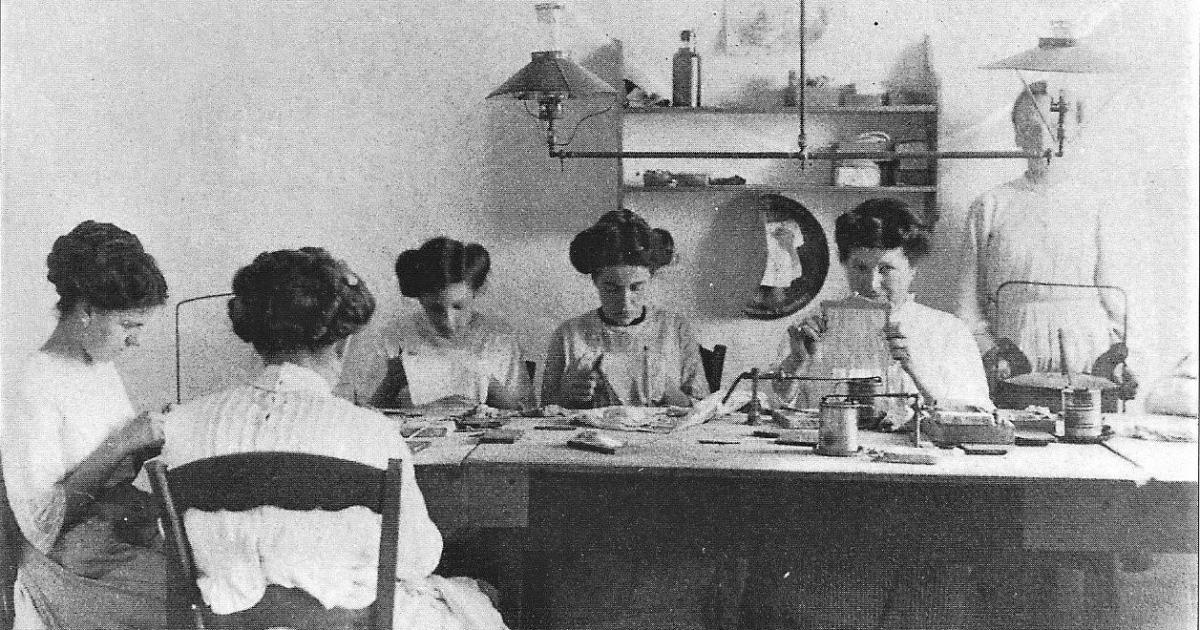
Shoe factory. Citadel, 1910s. | Photo: Collection of Magda Amorós
The Footwear Industry: A Sector Dominated by Women
The footwear industry, one of Menorca’s economic engines, was also one of the sectors where women played a significant role. Although men occupied positions of greater recognition and responsibility, such as master shoemakers, supervisors, and owners, women performed fundamental tasks like assembling, sewing, hemming, packing, finishing, and revising. These jobs were often done from home, allowing women to balance their work and family responsibilities.
In many cases, entire families worked in the footwear sector, with daughters learning the trade from their mothers and sisters. Women were also responsible for directing and finishing their father’s work, effectively acting as cobblers in their own right. Those who wanted to learn a trade but had no family connections would often apprentice with a mistress who taught them the necessary skills.
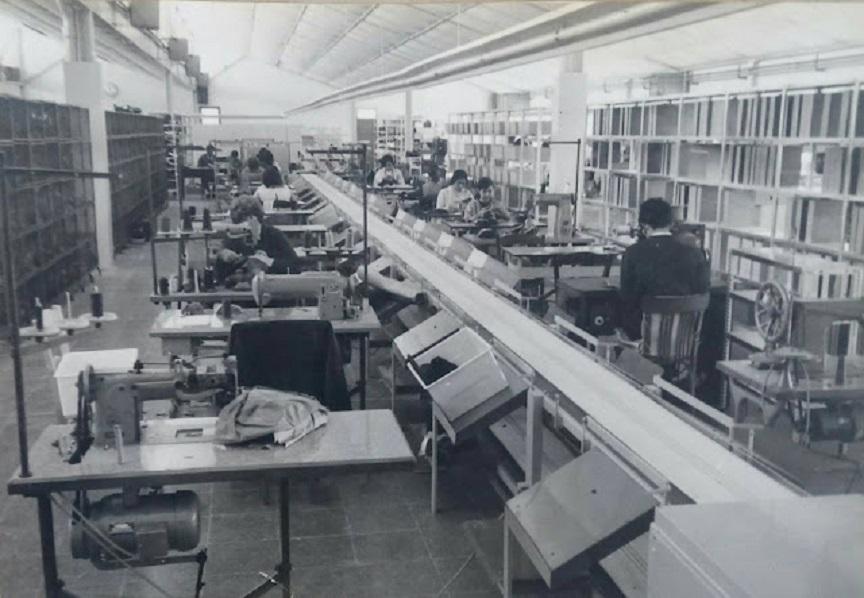
Awnings section of the Roseta factory. Citadel | Photo: Old Photos of Menorca
Jewelry and Other Industries: Women’s Contributions
Women also played a crucial role in the jewelry industry, particularly in municipalities like Maó and Ciutadella. The assembly of small pieces required precision and patience, qualities traditionally associated with women, which reinforced the feminization of the sector. However, this association also served to justify lower salaries and less professional recognition.
The Spanish Civil War and the subsequent post-war period marked a turning point for women in Menorca’s industry. With many men mobilized, imprisoned, or dead, women assumed even more responsibilities in factories and workshops, becoming the main economic support for many families.
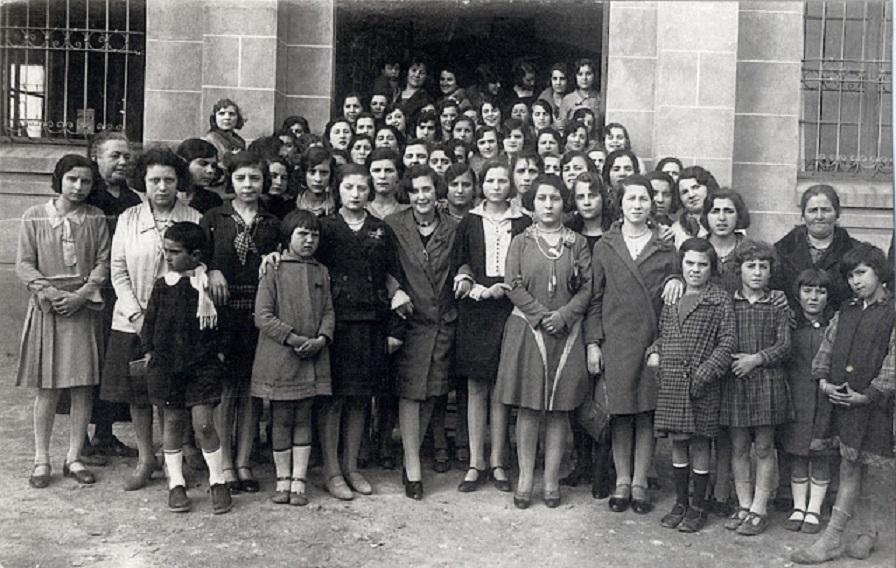
Women in their Pons Menéndez shoe factory. Citadel | Photo: Old Photographs of Menorca
Breaking the Silence: Recognizing Women’s Contributions
Despite their significant contributions, women’s roles in Menorca’s industry have been largely invisible in historical accounts. Business archives, economic chronicles, and institutional speeches rarely mention women workers, despite their numerical weight. This invisibility and silence were not accidental, reflecting a culture that valued male employment as productive and female work as complementary.
However, oral memory, passed down from mothers to daughters, has made it possible to reconstruct part of this history. Stories of endless days, cold hands, wages contributed to the family economy, and strong solidarity between colleagues are part of the female legacy of Menorca’s industry.
It was not until the second half of the 20th century that changes and conquests began to take place. Economic growth, tourism, and social changes transformed the situation of working women, with access to education, trade union movements, and feminism enabling them to demand better wages, formal contracts, and professional recognition.
Today, recognizing the work of these women is an outstanding social debt. It is not only an act of historical justice but also a way of understanding how Menorca’s economic progress was built. Women were not mere spectators of industrial development; they were silent protagonists, sustaining production and social fabric.
Rescuing their stories and placing them in the place they deserve is a necessary duty to complete the story of Menorca’s 20th century. Without them, the island’s industrial history is simply not understood. For more information, visit Here
Images Credit: www.menorca.info