

The Blue Economy: A New Era for Marine Conservation and Sustainable Development
The so-called blue economy has placed the sea at the center of the contemporary economic debate. Not only as a space to protect, but as an engine of innovation, growth and well-being linked to sectors as diverse as fishing, tourism, aquaculture or renewable energies. In island territories like Menorca, this interdependence between a marine environment in good condition and economic activity and social cohesion is especially evident. In this context, the Isla del Aire Marine Reserve has recently become an example of how this relationship can be managed intelligently through a participatory governance project promoted and accompanied by Menorca Preservation, a non-profit foundation that supports environmental projects on the island and works to raise funds locally and internationally in order to preserve the unique natural beauty and marine ecosystems of the island.
Context and Challenges
The creation of the Isla del Aire Marine Reserve in 2019 was conceived as a management instrument to regulate extractive uses and underwater activities in an area of high ecological value, with the aim of conserving marine resources and promoting the recovery of fishing populations, while guaranteeing compatibility with certain economic activities linked to the sea. From its first years, monitoring studies carried out by the Socio-Environmental Observatory of Menorca (OBSAM-IME) with the support of the Spanish Institute of Oceanography, showed that The protection applied allowed the fish biomass to double in the most protected areas and significantly increase its abundance, evidencing the direct benefits of management based on conservation.
However, the balance between conservation and uses was soon put to the test, since in 2022 the General Directorate of Fisheries of the Balearic Government, at the request of the Island Council of Menorca, modified the decree of the Marine Reserve, reducing by 22% the area where artisanal and recreational fishing was prohibited. This reopened the debate on how to manage a shared resource highlighting the need to incorporate more dialogue, data and participation in decision-making. This change highlighted the limitations of the participation mechanisms that existed up to that point and generated a feeling of disconnection between administrative decisions and the local community linked to the reserve.
Participatory Governance and Community Engagement
With this backdrop, Menorca Preservation together with GOB Menorca and OBSAM-IME, promoted between 2023 and 2024 a Participatory Governance Strategy with a horizon of four years and fifty concrete actions. The objective was not to replace the administration, but as a necessary response to rebuild trust, transparency and legitimacy in the management of marine space, creating a stable structure of dialogue, co-responsibility and informed decision-making. “From this strategy emerged the Social and Participatory Governance Forum of the Isla del Aire Marine Reserve (RMIA), formally established in February 2025 in which more than forty people from very different fields participated, from administrations, the fishing sector, diving centers, tourism companies, scientists and citizens, among others,” explains Aina Blanco-Magadán, project coordinator.
“It was not a rhetorical exercise, but rather we tried to identify real problems and viable proposals that could range from active surveillance, to the communication of regulations, environmental education, good nautical practices or involvement of the private sector,” he details. Beyond the identification of specific actions, The forum was conceived as a stable space for collective deliberation where different actors could contrast visions, build shared criteria and generate common positions that serve as a basis for dialogue with the administration and other decision-making levels.
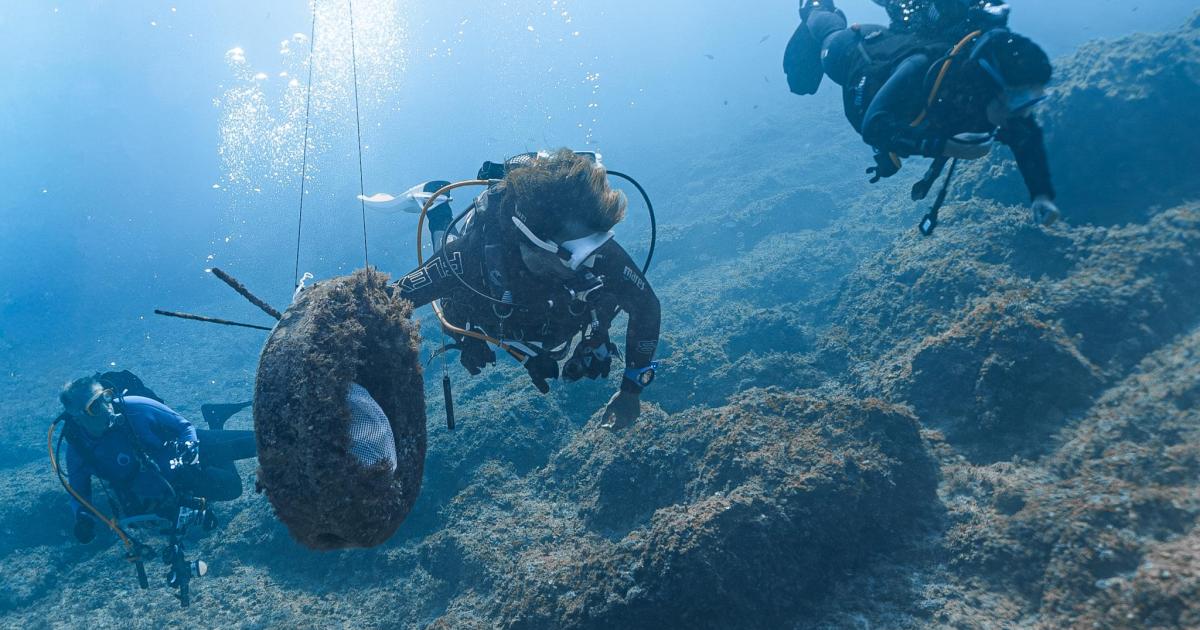
“The conclusions of the forum did not remain at the deliberative level but were translated into concrete actions, such as, for example, the day called ‘Weaving community under water’ and which last October brought together divers and land-based volunteers where we were able to remove more than 200 kilos of waste from the seabed and coastline,” he details. «Several bulky debris was located, such as two wheels, a fragment of boat fiber about two meters long and a chain about three meters long, which were removed with the help of diving teams. After collection, the waste was unloaded and classified with the support of Plastic Free Menorca, which provided the material for land collection and was in charge of coordinating the separation and classification of the waste together with the land cleaning volunteers,” explains the coordinator. In November they held a second edition of the Forum from which upcoming actions emerged such as the development of a guide to good practices and informative materials adapted to different audiences or strengthening collaboration with the administration by requesting a complementary protection figure and the installation of surveillance cameras in the reserve, among other actions.
Investment and Economic Benefits
One of the relevant elements of this entire process is that it has managed to translate conservation into a language understandable for the economic field. In this sense, a 2021 study carried out by the Marilles Foundation, in collaboration with the Balearic Center for Applied Biology and Ecoasa, showed that for every euro invested in the Levante Marine Reserve in Mallorca, 10 euros in benefits were generated, highlighting the economic value of properly managed marine reserves and the crucial role of community support in guaranteeing their success. So in this way, from 2023 Around 58,100 euros have been mobilized to launch the Forum and the first actions of the Participatory Governance Strategy, with the support of Menorca Preservation itself but also of entities such as the Marilles Foundation or the Leader Illa de Menorca Association.
“We consider that collaboration is the key when it comes to achieving community environmental awareness and that the actions we support have the maximum impact,” explains Rebecca Morris, current director of Menorca Preservation. «Marine protection should not be understood as a brake on development but an investment that, if managed with intelligence and social support, multiplies its impact. In a context of growing tourist pressure, this logic is especially relevant,” he adds.
Natural Accounting and Sustainable Development
The experience of the Isla del Aire Marine Reserve connects with a line of work increasingly present in public debate such as the incorporation of the value of natural capital in economic planning and decision making. The Balearic Islands have begun to explore natural capital accounting tools in marine protected areas with the aim of measuring more precisely what ecosystems contribute to the economy and what costs their degradation entails. This approach allows us to compare scenarios, justify public and private investments and understand the marine environment not only as a heritage to be preserved but as a strategic asset that supports key sectors and social well-being. “Initiatives such as Isla del Aire show that moving towards this model is not a theoretical abstraction, but a possible process when science, participatory governance and long-term commitment to the territory are combined,” concludes Morris.
Read more about the Isla del Aire Marine Reserve and its innovative approach to marine conservation and sustainable development Here
Images Credit: www.menorca.info