

Revolutionizing Healthcare: Vila Parc Clinic Introduces SPECT-CT Technology for Early Disease Diagnosis
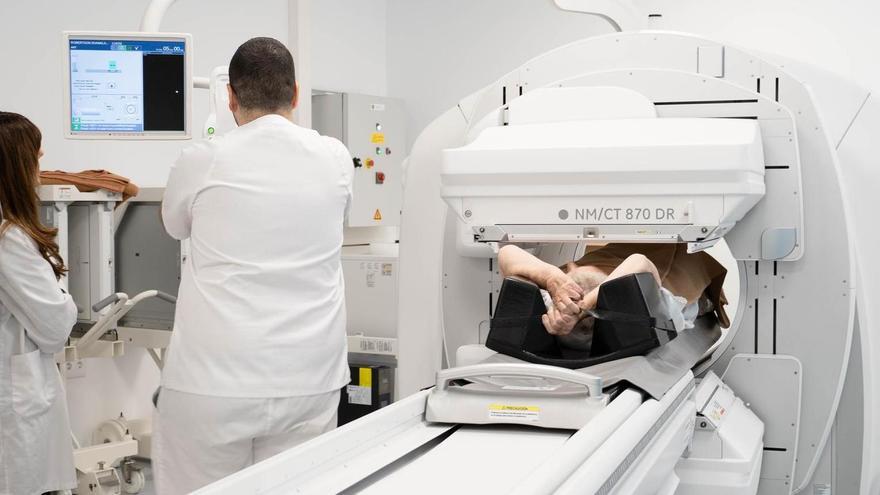
The Vila Parc Clinic in Ibiza has taken a significant leap forward in medical technology by incorporating a SPECT-CT (Single Photon Emission Computed Tomography) system from GE HealthCare. This cutting-edge tool enables the early diagnosis of various diseases, including cancer, by combining conventional scintigraphy with computed tomography. According to Dr. Pilar María, a specialist in Nuclear Medicine at the Policlínica Group, “The scintigraphy shows us the metabolic activity of the tissues we want to explore, while the CT scan helps us anatomically and structurally locate that metabolism.” This integration of two worlds offers valuable information for early diagnosis, making it a game-changer in the medical field.
Dr. Pilar María, specialist in Nuclear Medicine, reviews the images of a patient after the SPECT-CT test. / Polyclinic Group
How SPECT-CT Works
The SPECT-CT technique allows for the observation of both the structure of organs and tissues, as well as their functioning at the metabolic level. This enables the detection of alterations before symptoms appear, making it a powerful tool for early diagnosis. As Dr. Pilar María explains, “The SPECT-CT combines the best of two worlds and offers us very valuable information for early diagnosis.” The technology has already been applied to various medical specialties, including traumatology, cardiology, neurology, nephrology, endocrinology, and oncology.
Applications in Various Medical Specialties
The SPECT-CT technology has a wide range of applications, including:
In traumatology, it is especially useful for ruling out or confirming prosthetic mobilizations and detecting bone infections.
In cardiology, it allows for the assessment of ischemic pathology or perfusion problems.
In neurology, it is used to study dementia and neurodegenerative diseases.
In nephrology, it helps identify infectious renal lesions, particularly in pediatric patients.
In endocrinology, it enables the assessment of the thyroid, identification of parathyroid adenomas, and detection of neuroendocrine tumors.
In oncology, SPECT-CT facilitates the detection and localization of bone metastases in a single study, allowing for theragnosis, a medical field that combines diagnosis and treatment using radiopharmaceuticals to identify and treat the disease in a personalized way.
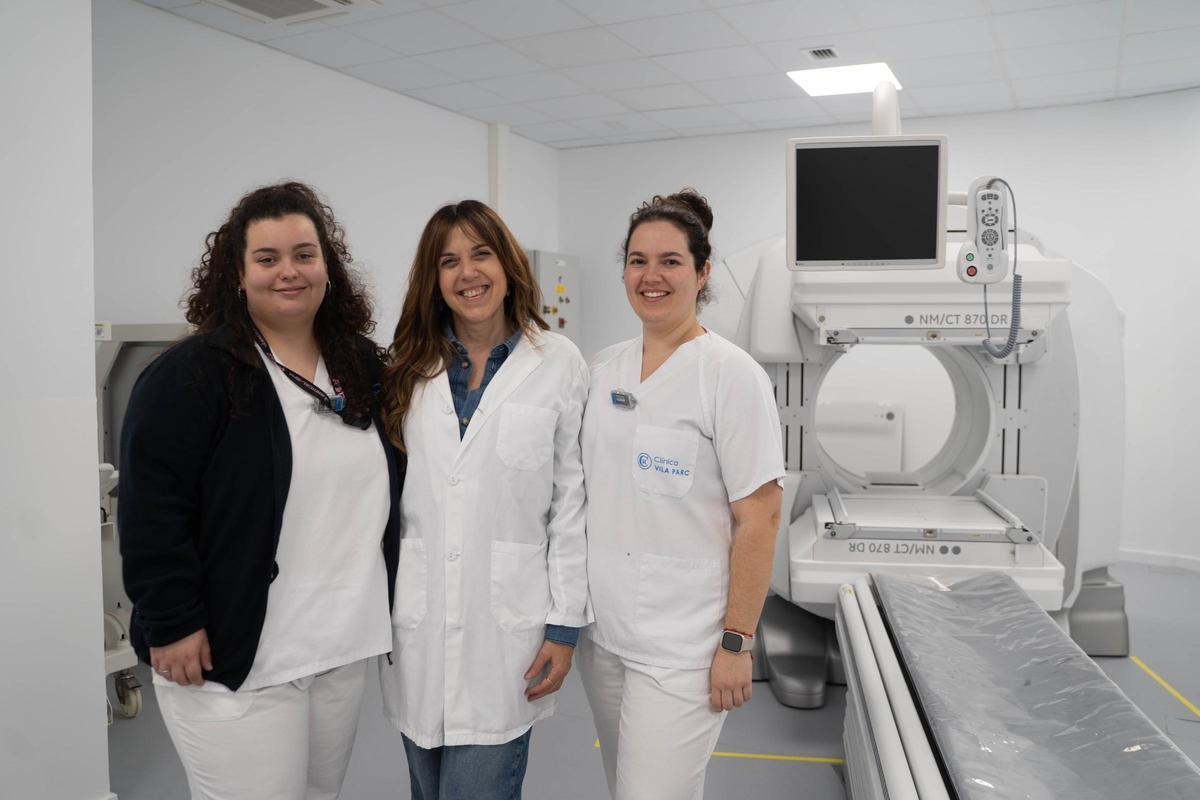
Dr. Pilar María, specialist in Nuclear Medicine (in the center), together with radiology technicians Júlia Morató and Melisa Ramon. / Polyclinic Group
Advantages of SPECT-CT in Disease Detection
According to Dr. Pilar María, “Since what we observe is the metabolism of tissues, we can detect diseases in very early stages.” This is essential for the patient’s prognosis and treatment, as it allows for the anticipation of structural damage and adaptation of clinical decisions to each case. The SPECT-CT technology also includes a nuclear medicine workstation that integrates quantification applications powered by artificial intelligence (AI), functioning as an image processing, analysis, and review platform.
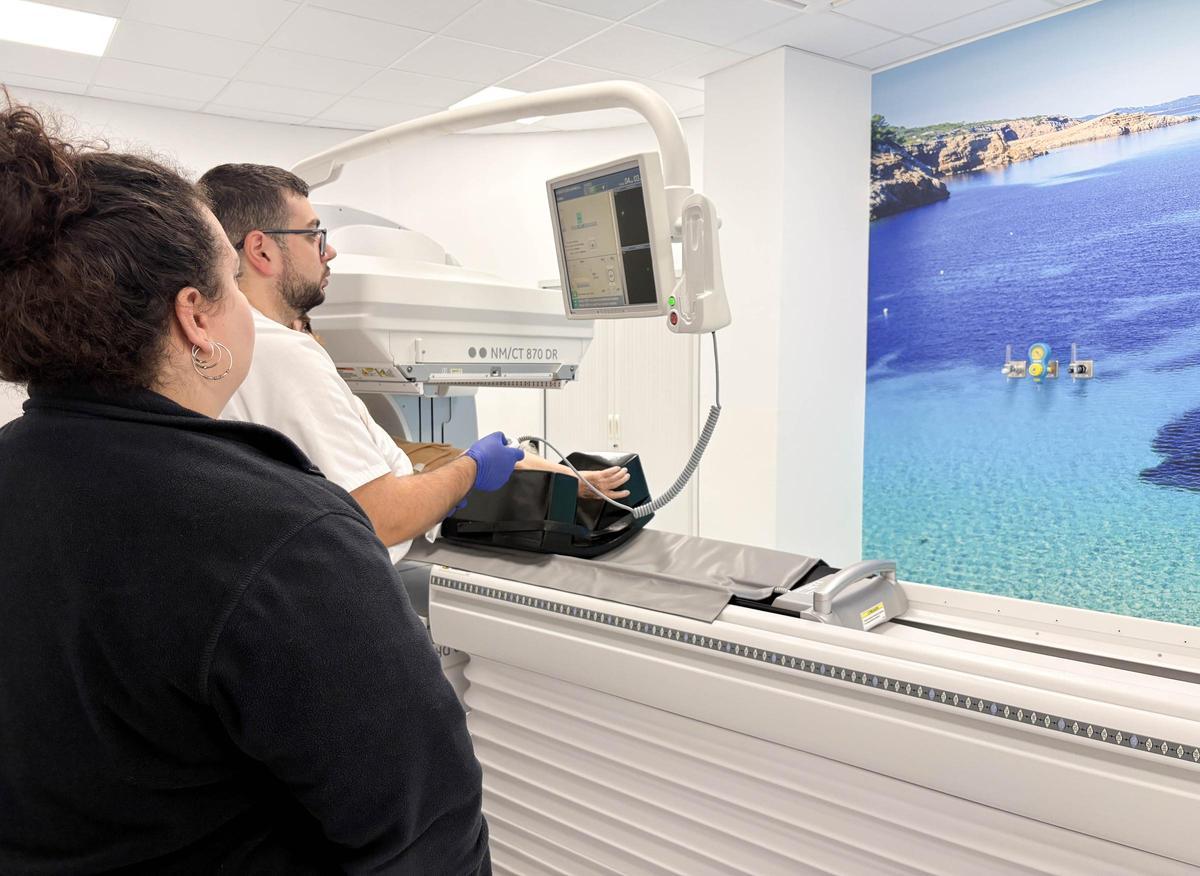
SPECT-CT allows for more precise and earlier diagnoses. / Polyclinic Group
Differentiation from PET-CT
The SPECT-CT technology joins PET-CT as one of the great tools of modern nuclear medicine, now fully operational in Ibiza. While both techniques are complementary, SPECT-CT uses gamma radiation and radiopharmaceuticals such as Technetium-99m or Iodine-123, making it a more accessible and versatile procedure. PET-CT, on the other hand, uses radiopharmaceuticals such as FDG labeled with Fluorine-18, offering greater sensitivity in the detection of oncological metabolic processes.
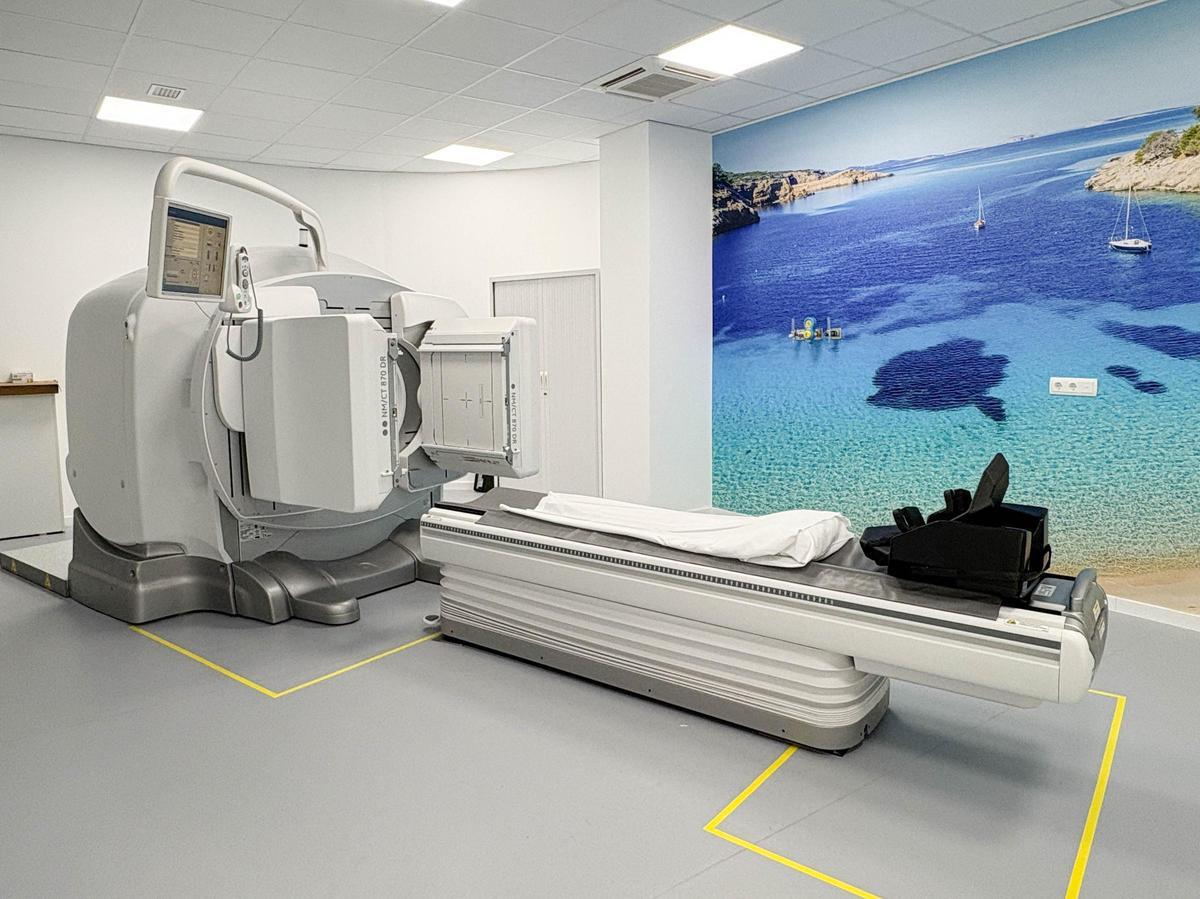
The new SPECT-CT technology is now working at full capacity at the Vila Parc Clinic in Ibiza. / Polyclinic Group
Cases Treated with SPECT-CT
The Vila Parc Clinic has already treated various cases using the new SPECT-CT technology, including:
- Breast cancer: Precise location of the sentinel lymph node.
- Cardiology: Advanced study for ischemic heart disease.
- Endocrinology: Parathyroid scan to locate parathyroid adenoma.
- Oncology: Study of neuroendocrine tumors.
SPECT-CT opens new diagnostic possibilities in multiple specialties, with greater precision and speed. Patients no longer need to travel to Mallorca to benefit from this technology.
Contact Information
Telephone: 971 302 354
WhatsApp: 672610125
Web: www.clinicavilaparc.es
For more information, visit Here
Images Credit: www.diariodeibiza.es