

Fernando Brambila: The Painter Who Mapped Royal Spaces
Early Life and Training
Fernando Brambila was born in 1763 in Cassano d’Adda, a small town in northern Italy. He studied perspective and architecture, skills that later let him turn cities and landscapes into precise visual records. His training gave him an eye for detail that would serve both scientists and royalty.
Joining the Malaspina Expedition
In the late 1700s Brambila joined the scientific voyage led by Alejandro Malaspina. The expedition’s goal was to chart Spanish territories across the Pacific. Brambila’s job was to draw ports, forts, monuments, and street plans of places like Guam, Manila, Macau, Sydney, Lima, and Montevideo. These sketches were more than pretty pictures; they supplied the navy with useful information about defenses and urban layouts at the end of the Age of Enlightenment.
From Explorer to Court Painter
After returning to Spain, Brambila’s talent caught the eye of the monarchy. In 1799 King Charles IV named him Chamber Painter, Architect, and Adorner. This role let him work closely with the royal family, but his true passion lay in capturing places rather than people.
The Royal Sites Series
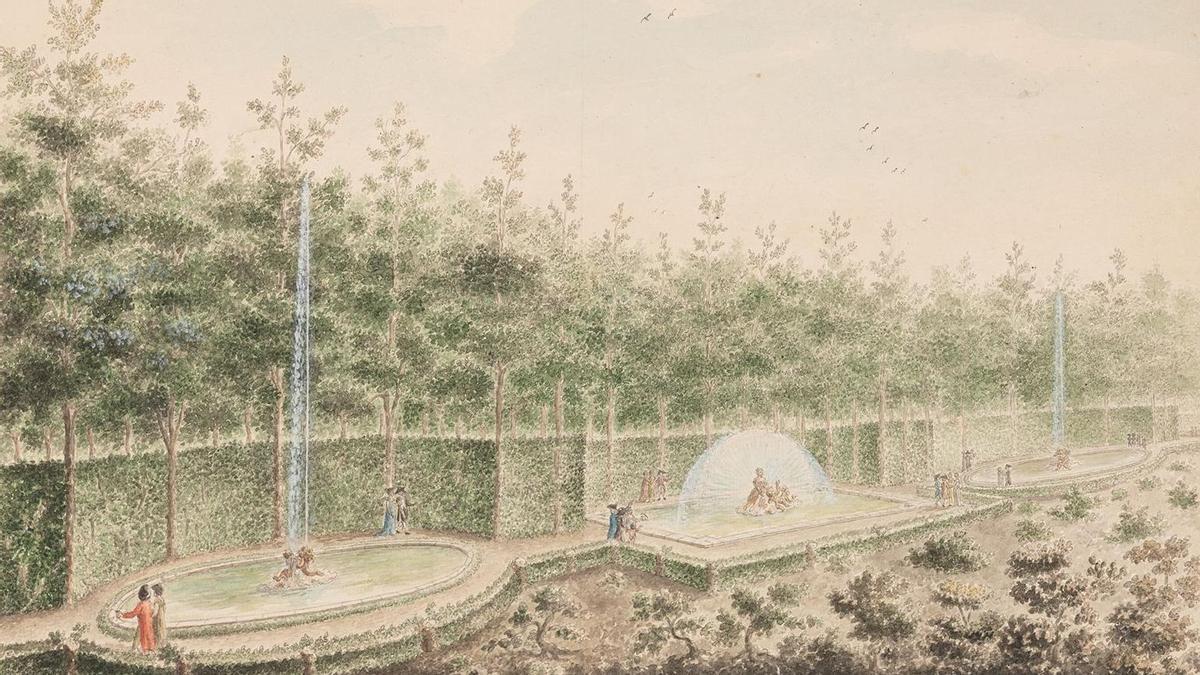
Between 1821 and 1833 King Ferdinand VII commissioned Brambila to paint a series of views of the Royal Sites—Aranjuez, La Granja, El Escorial, and the Royal Palace of Madrid. The works were oil on canvas, meant to hang in palace cabinets. Through prints they spread beyond the walls, creating a shared visual memory of these landmarks for the Spanish public.
Blending Survey and Stagecraft
Brambila’s paintings sit between two worlds. As a surveyor, he measured streets, façades, gardens, and canals with scientific accuracy. As a set designer, he arranged those elements to look dignified and theatrical, as if preparing the scene for a royal procession. His ruins after the Napoleonic siege of Zaragoza, for example, turn destruction into a quiet testimony, showing how image can shape memory of power.
Why His Work Matters Today
The current exhibition at the Gallery of the Royal Collections (open until October 12) brings together about thirty of his pieces, many never shown together before. Curator Isabel María Rodríguez Marco argues that Brambila is key to understanding how Spain’s visual identity formed. In an age where images flash by in seconds, his careful views ask us to slow down and consider how much of what we “remember” about a place comes from direct experience versus the pictures we have inherited.
A Lesson in Looking Slowly
Brambila’s legacy reminds us that a painting can be both a document and a work of art. By studying his precise yet evocative views, we see how landscapes were used to express state power, dynastic pride, and cultural memory—ideas that still influence how we picture royal palaces today.
Conclusion
Fernando Brambila may have worked behind the scenes of grand portraits and epic histories, but his quiet, exact eye helped shape the way Spain sees its own heritage. His work bridges science and spectacle, offering a timeless invitation to look closely, think deeply, and appreciate the stories hidden in every line of a cityscape.
Source
Images Credit: www.diariodeibiza.es